The Euro and the Battle of Ideas by Markus K. Brunnermeier & Harold James & Jean-Pierre Landau
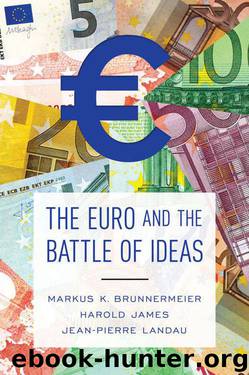
Author:Markus K. Brunnermeier & Harold James & Jean-Pierre Landau [Brunnermeier, Markus K.]
Language: eng
Format: epub
Publisher: Princeton University Press
Published: 2016-08-03T21:00:00+00:00
Policy Recommendations
As we have seen in this and the previous chapter, the Maastricht Treaty woefully neglected the modernization and internationalization of banking as well as the complexity of an unbalanced integration, and so it is unsurprising that the euro area was ill-equipped to deal with the complicated fallout from the global financial crisis. In particular, the threat of financial dominance—completely ignored in the Maastricht Treaty—gave rise to a second layer in the game of chicken between monetary and fiscal authorities.
European policy makers struggled to find solutions to these problems. In theory, most of them required further integration, but the political environment made it difficult to make progress on that aspect. Paradoxically, France was willing to transfer resources but not power, especially budgeting power, to Europe, while Germany was reluctant to transfer more resources to Brussels to bail out (foreign) banks. As a consequence, a search ensued to find the minimal measures that limit the adverse implications of and spillovers from banking sector crisis, de facto pushing responsibility to act to the ECB, at least in the short term.
Liquidity-focused short-term responses raise long-term moral hazard issues, so policy makers at the same time needed to have a vision for a future institutional structure that would effectively deal with these problems. The basic idea of an adequate institutional environment that balances both forces is to not save the few worst performers and erect a firewall protecting the rest, in the hope of triggering a virtuous race away from the bottom that stabilizes the whole system. For the euro area, the recent move toward a banking union points in this direction. However, as we have seen, there is as of yet no area-wide safe asset, nor is any such asset on the horizon, even though precisely this will be indispensable for smooth functioning of the banking union.
One bold move forward could be to establish a European banking charter that makes the financial sector truly European, in other words, makes Europe like a county with respect to banks. All aspects of finance—regulatory and supervisory but also fiscal—would be moved to the European level. In good times, tax revenue from banks would thus accrue to a European budget, while in bad times, this taxing power could provide the necessary backstop to guarantee restructuring without adverse spillover and contagion effects. This would be unpopular with small countries with large financial sectors, but also politically impossible for the United Kingdom.
Download
This site does not store any files on its server. We only index and link to content provided by other sites. Please contact the content providers to delete copyright contents if any and email us, we'll remove relevant links or contents immediately.
International Integration of the Brazilian Economy by Elias C. Grivoyannis(111322)
The Radium Girls by Kate Moore(12096)
Turbulence by E. J. Noyes(8121)
Nudge - Improving Decisions about Health, Wealth, and Happiness by Thaler Sunstein(7761)
The Black Swan by Nassim Nicholas Taleb(7200)
Rich Dad Poor Dad by Robert T. Kiyosaki(6728)
Pioneering Portfolio Management by David F. Swensen(6342)
Man-made Catastrophes and Risk Information Concealment by Dmitry Chernov & Didier Sornette(6142)
Zero to One by Peter Thiel(5874)
Secrecy World by Jake Bernstein(4804)
Millionaire: The Philanderer, Gambler, and Duelist Who Invented Modern Finance by Janet Gleeson(4539)
The Age of Surveillance Capitalism by Shoshana Zuboff(4355)
Skin in the Game by Nassim Nicholas Taleb(4310)
The Money Culture by Michael Lewis(4268)
Bullshit Jobs by David Graeber(4252)
Skin in the Game: Hidden Asymmetries in Daily Life by Nassim Nicholas Taleb(4052)
The Dhandho Investor by Mohnish Pabrai(3826)
The Wisdom of Finance by Mihir Desai(3793)
Blockchain Basics by Daniel Drescher(3641)
